Requirements for migrants are being significantly tightened
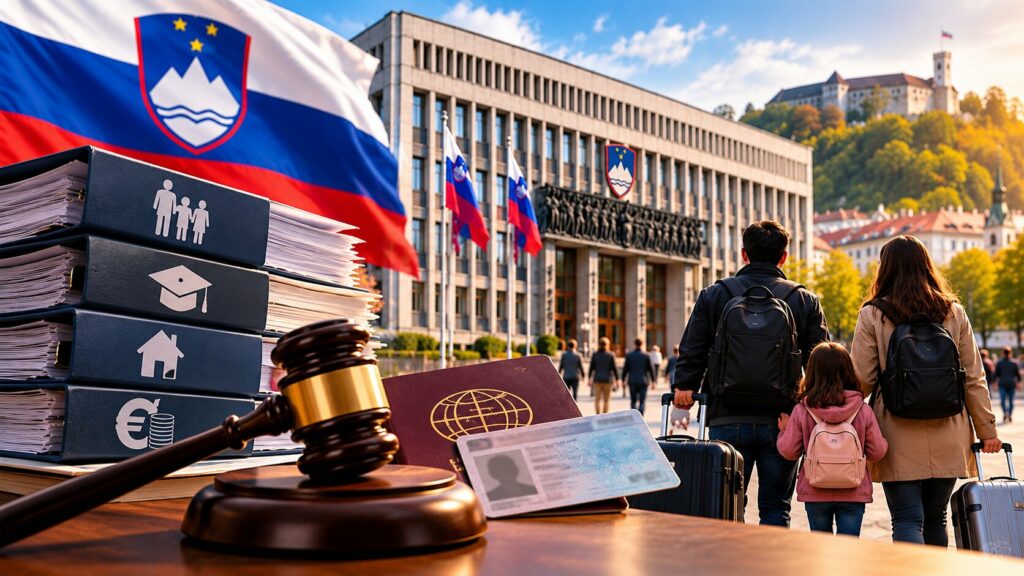
Slovenia’s Ministry of the Interior and Public Administration has revised the draft amendments to the Foreigners Act and extended the public consultation until August 26.
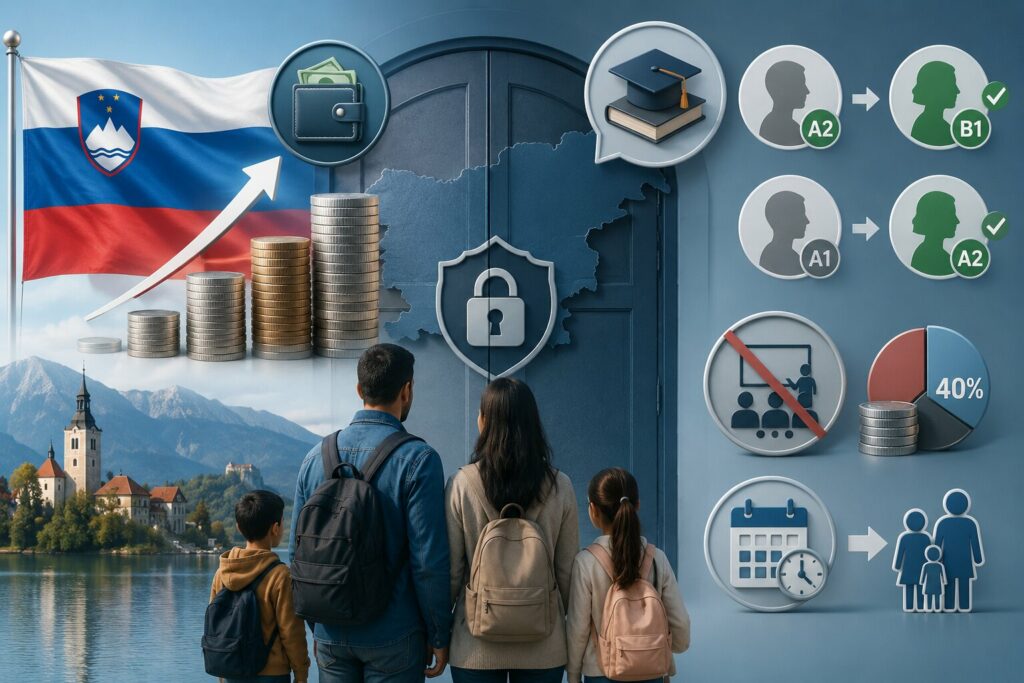
The key change is that the required means of subsistence will increase from €507 to €1,015 (double the basic minimum-income amount). This is roughly equivalent to the country’s minimum net wage.
Slovenian language requirements are also being tightened: to extend a temporary residence permit for family reunification, A2 level will be required instead of the basic level, while for permanent residence, B1 will be required instead of A2.
Other changes include the end of free Slovenian language courses (40% co-financing will be introduced) and an increase in the waiting period before family reunification is possible — from one year to three years.
Requirements for migrants are being significantly tightened
Slovenia’s Ministry of the Interior and Public Administration has revised the draft amendments to the Foreigners Act and extended the public consultation until August 26.
The key change is that the required means of subsistence will increase from €507 to €1,015 (double the basic minimum-income amount). This is roughly equivalent to the country’s minimum net wage.
Slovenian language requirements are also being tightened: to extend a temporary residence permit for family reunification, A2 level will be required instead of the basic level, while for permanent residence, B1 will be required instead of A2.
Other changes include the end of free Slovenian language courses (40% co-financing will be introduced) and an increase in the waiting period before family reunification is possible — from one year to three years.
Short-term accommodation in Slovenia continues to break records.
In 2025, more than 523,000 bookings for short-term accommodation were made through the four major international online platforms (Airbnb, Booking, Expedia Group and Tripadvisor) — 16% more than in the previous year. Based on these bookings, tourists spent 4.53 million nights in short-term accommodation, an increase of 14% compared with 2024. At the same time, 70% of all overnight stays in short-term accommodation were booked through these platforms. 91% of bookings were made by foreign tourists. In 2025, tourists from Germany accounted for the highest number of overnight stays, with 698,000 nights, followed by visitors from the Czech Republic, Italy, Hungary and France. The peak season was July and August, when almost 197,000 bookings and around 2 million overnight stays were recorded. Source: rtvslo.si
From Finance to Pizzaiolo: An American Success Story in Ljubljana
Greg Yurkovich, who holds a degree in political science and previously worked in finance and private equity investment, made a radical career change several years ago — moving from California to Ljubljana and opening a pizzeria.
With no prior experience making pizza, Yurkovich traveled to Naples to learn the craft. His very first pizza was a complete disaster, but through perseverance and hundreds of attempts, he eventually mastered the art of pizza-making.
Today, his restaurant, Pop’s Pizza Place, ranks 34th in the 50 Top Pizza Europe ranking — a list of the continent’s best pizzerias. The secret to his success: dough made with wine yeast, a 36-hour fermentation process, and carefully selected Italian ingredients.
Yurkovich believes that guests should always receive more than they expect.
80% of applicants admitted in the first admission round
The Ministry of Education, Science and Youth has published the results of university admissions for the 2026/27 academic year.
Out of 18,905 places available at public and concession higher education institutions, 12,454 have been filled. These students were admitted to bachelor’s and integrated master’s degree programs. Of them, 80% were enrolled in the study program they had listed as their first choice.
A total of 3,715 applicants were not admitted to any of the programs they had applied for because they either did not pass the secondary school leaving examination (Matura) or did not meet the admission requirements. Another 470 applications are still under review. These include applicants taking the Matura in two stages, those scheduled to take aptitude tests in the autumn, or those awaiting recognition of their foreign educational qualifications.
The results are available on the eVŠ portal via the SI-PASS system. Applicants have 21 days from receiving the decision to file an appeal. Enrollment takes place from July 24 to August 14.
Slovenia Ranked 7th Among the Safest Countries in the World
According to data from the Institute for Economics and Peace, Slovenia ranked 7th out of 163 countries in the 2017 ranking of the world’s safest countries, improving its position by three places compared with the previous year.
The Institute for Economics and Peace assesses safety levels using 23 indicators, including crime rates, relations with neighbouring countries, political terror, arms imports and exports, the number of refugees, homicide rates, and suicide rates. Each indicator is scored on a scale from 1 to 5, with lower scores indicating a higher level of safety.
For the tenth consecutive year, Iceland topped the global ranking, while Syria, Afghanistan, and Iraq occupied the bottom positions.
The top 10 safest countries in the world, according to the Institute for Economics and Peace, are:
Slovenia Among the Top Three EU Countries with the Lowest Risk of Poverty and Social Exclusion
Slovenia ranked third among EU countries with the lowest share of people at risk of poverty or social exclusion. In 2025, 15.5% of the country’s population was considered at risk.
The best results were recorded in the Czech Republic (11.5%) and Poland (15%).
The highest levels of risk were reported in Bulgaria (29%), Greece, and Romania.
Across the European Union, an average of 20.9% of residents are at risk of poverty or social exclusion, representing 92.7 million people.
Starting 15 June, the Slovenj Gradec General Hospital is closing part of its internal medicine department, reducing capacity by 10 beds due to an acute shortage of medical staff.
The situation has become critical: both the internal medicine and paediatric departments currently have no heads of department. Several doctors have recently left for outpatient health centres, where working conditions are more favourable — daytime shifts only, without night duties, weekends, or holiday work.
The remaining staff are working under enormous pressure, with some physicians holding multiple positions simultaneously. The problem is compounded by shortcomings in the organization of the emergency care centre, where family physicians are expected to provide cover. In the Koroška region, however, this system functions only during nights and weekends.
Former head of the internal medicine department, Klemen Mojškerc, who stepped down last autumn because of the staffing crisis, warned: “If the hospital does not close itself down, no one else will need to do it.”
Doctors are urging local authorities to take a more active role in finding solutions to the staffing crisis.
Five Schools in the Gorenjska Region Introduce Enrolment Limits
The application period for enrolment in Slovenian secondary schools for the next academic year has officially ended. A total of 23,580 candidates submitted applications by the 6 May deadline.
Across the country, 65 schools have introduced enrolment limits, including five schools in the Gorenjska region:
France Prešeren Grammar School in Kranj — economics study programmes and sports classes
Radovljica Educational Centre — cosmetology and gastronomy with tourism
Jesenice Secondary School — preschool education
Radovljica Economic Grammar School — economics technician study programme
Kranj School Centre — hairdresser, construction technician, nursing technician, and several technical study programmes
Particularly high demand this year was recorded for hairdressing and auto mechanic study programmes. As in previous years, studies in economics, construction, information technology, and healthcare remain highly popular.
Approximately 2,800 places remain available for applicants in the second round of admissions.
Applications for Student Dormitory Places to Open Soon
Students will be able to apply for subsidised accommodation in student dormitories for the 2026/2027 academic year from 1 July. The Ministry of Higher Education has announced 12,883 subsidised places, plus an additional 32 places for students granted international protection.
Key dates:
Applications open: 1 July 2026
Deadline for inclusion in the first priority list: 18 August
Deadline for renewing accommodation: 18 August
Subsidy amounts:
Public student dormitories: €41.46 per month
Private student dormitories: €103.36 per month
Eligibility requirements: applicants must have student status, must not be employed, and the distance between their permanent residence and place of study must be at least 25 kilometres. Social circumstances are also considered: the average family income must not exceed 150% of the average salary in Slovenia.
The results of admissions to secondary schools for the 2026/2027 academic year have highlighted a serious issue: young people continue to avoid professions that are most needed by the Slovenian economy. The lowest interest is seen in study programmes related to engineering, construction, mechanical engineering, electrical engineering, hospitality, logistics, healthcare, and social services. Although places are available in these study programmes, including slots for international students, many remain unfilled.
Meanwhile, employers continue to face a shortage of qualified workers and technicians. If current enrolment trends continue, the problem is expected to worsen in the coming years. Experts believe that vocational education must become more attractive by strengthening cooperation between schools and employers, modernising equipment, highlighting successful graduate career paths, and promoting vocational schools where students can apply after completing compulsory education.
Many young people avoid these fields because they do not fully understand the nature of the professions, perceive the study programmes as too difficult, or are concerned about specific working conditions. However, statistical assessments show that most students who performed well in mathematics and physics adapt successfully to technical specialties, where labour shortages are particularly severe. In many cases, concerns disappear during the first year of study, when students become familiar with the profession.
Experts are calling on schools to organise more career guidance activities, while companies facing staff shortages are encouraged to promote job opportunities more actively through career fairs and open days at educational institutions.
2TM always helps future students choose educational institutions and study programmes where they have a strong chance of admission, while providing access to high-quality, in-demand qualifications. Students also gain strong opportunities to begin building a successful career during their studies, increasing their chances of securing stable and well-paid employment after graduation.
From a Student to a Participant in a Diplomatic Meeting at the Presidential Level
The intersection of dreams and perseverance gives birth to real success stories.
One of our students, Shakhrier Iskhakov from Uzbekistan, has become a living proof of how education can open doors to the highest level of international interaction.
Last year, Shakhrier entered the University of Ljubljana with the assistance of our team and began to study the Slovenian language at our language school — from zero to B1 level. In a short time, he managed not only to master the language, but also to become a truly integrated participant in the academic and public environment of Slovenia.
On 22 May 2025, Shakhrier found himself at the centre of an important international event — the meeting of the Presidents of Uzbekistan and Slovenia. Thanks to his knowledge of the Slovenian language, he functioned as an intermediary in communication between the leaders of the two countries.
This became not only a personal achievement but also a symbol of how much education can influence your destiny.
During the meeting, the President of Uzbekistan had a personal conversation with Shakhrier, expressing gratitude for his desire for knowledge and the intention to develop projects in the field of artificial intelligence after returning home.
The President’s words were an inspiring message:
“You will become that bridge which will connect the great results achieved here with our people.”
We are proud of Shakhrier and excited to be a part of his life experience. His story is a reminder that even the first step in learning a language can lead to a dialogue at the highest level.
University of Novo Mesto to Become a Public University
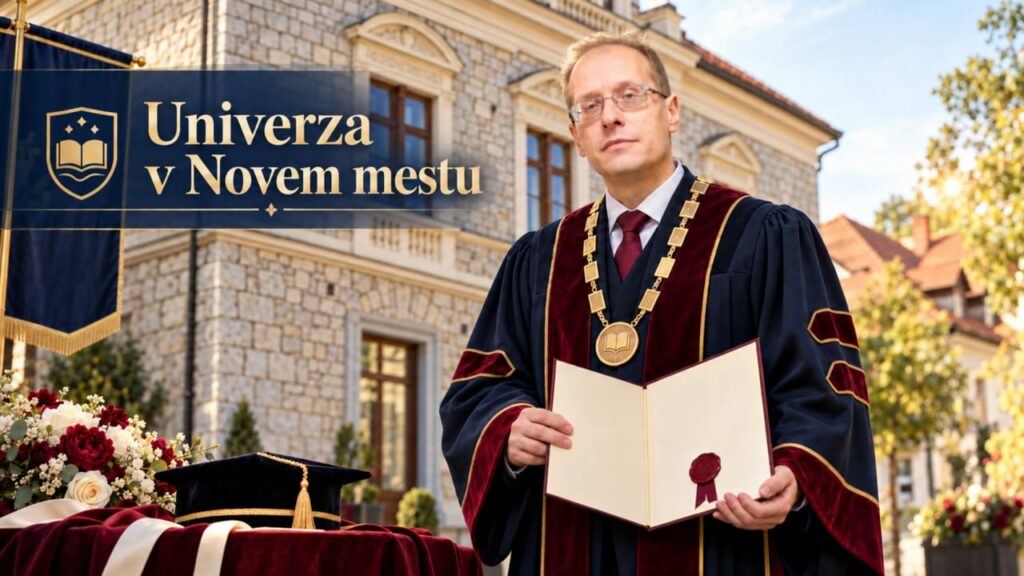
The new public University of Novo Mesto will be entered in the court register by the end of June, acting rector Janez Povh announced during a visit by the Minister of Higher Education, Igor Papič.
Two parallel processes are currently underway: the removal of the private university from the register and the preparation of documents required to transfer staff and students from private faculties to the new public university.
The university will temporarily operate from the municipal administration building, where an official plaque was unveiled yesterday. After the renovation of the Narodni Dom building has been completed in July, the university’s main office will be relocated there. In the longer term, the institution may move to a university campus in the Drgančevje area.
Elections for a new rector are scheduled for September, with the successful candidate assuming office on 1 October. Povh has stated that he does not currently intend to run for a full term. The minister also confirmed that the funding agreement for the university’s first and second years of operation has already been signed.